
Fun St Kilda Fact - September 2026 - St Kilda Memorial Hall
The St. Kilda Memorial Hall was first proposed in 1920, when it was decided that the Hall’s activities should generate revenue devoted to the relief of distressed soldiers and their families.
In 1924 the Memorial Hall was opened by the Governor of Victoria, the Earl of Stradbroke. The completed building was four stories high including 12 apartments to accommodate returned servicemen and four shops. The grand hall at the rear of the building could accommodate 500 for dancing and seat 1,000.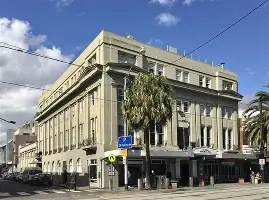
The inaugural event was an evening Ball and the venue was a popular as a dance hall. Following the rise in popularity of cinema, the grand hall was leased and converted into The Memorial Picture Theatre from 1927 to 1958, when it became affectionately known as ‘The Memo’.
The grand hall went on to become home to Telefil recording studios from 1961 to 1965. Normie Rowe, Olivia Newton John and The Easybeats are some famous Australian performers who were recorded there.
From 1974 to 1992 Pan Pacific Pictures leased the hall as a film studio. Until 1979 almost all of all Val Morgan cinema ads screened across Australia were recorded there as well as all the TV ads for TV Week, New Idea and The Women’s Weekly. These included weekly shoots of Bert Newton, Michael Pate, Pattie Newton, Debbie Byrne, Jamie Redfern, the cast of Homicide, Matlock Police, The Box and No. 96.
The building’s 12 apartments, are still home to returned servicemen and are managed by the St. Kilda Memorial Hall Trustees.
Fun St Kilda Fact - August 2026 - National Theatre
Did you kno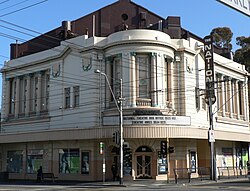 w? The building now occupied by the National Theatre was built in the Beaux Arts style as a 3000-seat cinema and opened in 1921 as the Victory Theatre. In 1928 it was rebuilt in a more luxurious manner, with fewer seats, a larger balcony, and a much grander foyer.
In 1971 Hoyts (which operates movie theaters) offered the National Theatre Company the Victory Theatre for conversion to a live theatre and rehearsal spaces. The current theatre consists of the original Victory dress circle extended with the addition of a sizeable stage and a fly tower. The original stalls were converted into five studios for drama, opera and ballet. One of the studios is itself a theatrette. The theatre opened in its current guise in August 1974, while the schools and administration moved there in September 1972.
(wikipedia)
Fun St Kilda Fact - July 2026 - Catani Gardens
Did you know St Kilda's Catani Gardens were built on reclaimed land?
Approximately 6 hectares of land were reclaimed 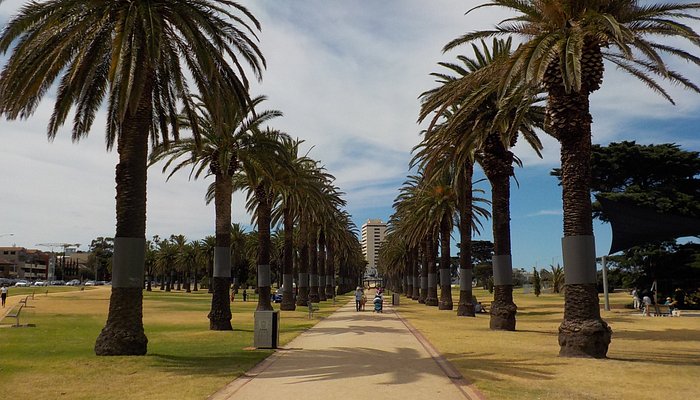 from the sea between 1890 and 1916, led by Italian-Australian civil engineer Carlo Catani, who designed the gardens to embody a Mediterranean-style seaside promenade.
The main landscaping and planting were completed by the late 1920s. The prime landscape feature of the Gardens is its extensive use of palms arranged in rows and grand avenues along principal axes of the Gardens, with secondary promenades of Monterey Cypress.
The Catani Gardens are of historical, aesthetic, architectural and scientific (horticultural) importance to the State of Victoria.
(heritage.vic.gov.au)
Fun St Kilda Fact - June 2026 - Bygone Public Transport in St Kilda
The cross-town Windsor - St Kilda Line opened on 17 October 1891, and ran from Chapel Street near Windsor Railway Station, along Wellington Street, crossing the Brighton Road Line, then Fitzroy Street, the Upper Esplanade (with a view of St Kilda Beach), and Acland Street to terminate at Barkly Street. It closed in 1925.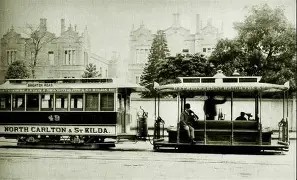
Fun St Kilda Fact May 2026 St Kilda Cinema - The Astor Theatre
The Astor Theatre is a classic, single-screen jazz moderne revival movie theatre in the Melbourne suburb of St Kilda, first opened in 1936 and still in operation today.
The site has been used for entertainment purposes since the Diamond Picture Theatre opened there on 29 July 1912. The current building was constructed in 1935, with aseating capacity of 1,673 people. Notably it was one of the last theatres in Melbourne to use the traditional two-level auditorium layout.
The Astor website notes that: "The Astor Theatre is listed on the Victorian Heritage Register, under record number H1751, this heritage protection ensures the preservation and longevity of the building. This heritage protection also demands that all original fixtures remain, for example, if you ever wondered why The Astor’s auditorium seating feels a little dated and lacking in modern comforts, well, that is because the many seats in the Astor can not be updated due to their heritage value and protection. We kinda like them that way too. More information on The Astor’s heritage value to the state of Victoria can be found here."
Wikipedia
Fun St Kilda Fact Apr 2026 - St Kilda Name
Before being officially named St Kilda in 1842 by Charles La Trobe, who was superintendent of the Port Phillip District of New South Wales, white settlers initially called the area Green Knoll. It was eventually named after the schooner Lady of St Kilda,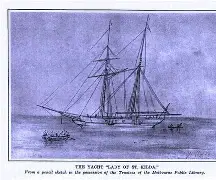 which was owned between 1834 and 1840 by Sir Thomas Acland. Acland sold the vessel in 1840 to Jonathan Cundy Pope of Plymouth. The vessel sailed for Port Phillip in February 1841.The ship was used in Port Phillip as a cargo vessel; in January 1842 it was docked in Hobson Bay and listed for sale by exchange of sheep. The vessel was moored at the main beach for the early part of 1842, which was soon known as "the St Kilda foreshore".
The schooner Lady of St Kilda was named in honour of Lady Grange, who was imprisoned by her husband between 1734 and 1740 on the island of Hirta, the largest island in the St Kilda archipelago, on the western edge of Scotland.
Wikipedia
Fun St Kilda Fact Mar 2026
Leo’s Spaghetti Bar started life as a small, chrome and Laminex hidey-hole in Fitzroy Street, St Kilda, serving simple and authentic Italian food. It opened its doors in 1956—the same year as the Melbourne Olympics.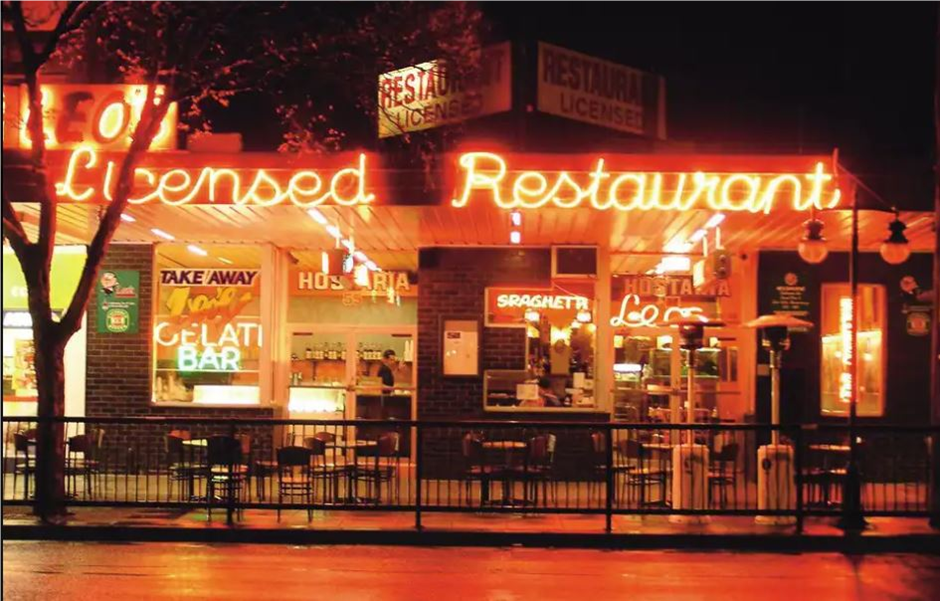
Leo (Pantaleo) Mastrototaro based his business model on the theory that 20 minutes was enough time for anyone to eat lunch. If you stayed longer than that, a waiter would wipe down your table, and then hover until you took the hint and left.
The restaurant moved to a much larger premises at 51-55 Fitzroy Street in 1970. A liquor license was procured, and a decorator was engaged. The food didn’t change much, but the Laminex and chrome were exchanged for exposed brick, chunky wood, walls decorated with pictures of English pubs (inexplicably!), and with brickwork out the front that spells the name LEO.
Fun St Kilda Fact Feb 2026
St Kilda Sea Baths
In the 19th century, swimming from the open  beach was prohibited during daylight hours, so bathers were compelled to keep within the baths. After the 1850s, sea bathing became acceptable, but only within large timber structures that protected swimmers from predatory marine life. Women were also protected from the sight of men bathing because men frequently bathed naked. Throughout the 19th century, there were as many as six different sea baths operating along the St Kilda shore, giving St Kilda its reputation for therapeutic sea air, ozone and ‘a dip in the briny’. It wasn’t until the 1920s that the council by-laws were changed to make it legal for men and women to take an unprotected dip in the bay!

The Joker Ghost of Luna Park
This ghost has been known to appear in the Scenic Railway and on the Ferris Wheel to spook riders before disappearing into thin air. But who is this mysterious figure? There are a number of different theories. One is that he is a snake charmer who was bitten on the neck by one of his tiger snakes during a performance. Another is that it is the spirit of a man who, while riding the Scenic Railway, turned to speak to someone behind him and in doing so, leaned out of the cart and hit his head on an oncoming support pole. The list of possible identities is possibly the most frightening thing about this particular story but don’t be surprised if you see this trickster (and for goodness’ sake, keep your arms, legs and head inside the rides!)
Fun St Kilda Fact Nov 2025
The 1855 race meet near the now 170-year-old St Kilda institution, the Village Belle Hotel, featured a nag named Asparagus, which, it turns out, is Aussie racing slang for a punter with more tips than a tin of asparagus.
 1860 photo courtesy St Kilda Historical Society
Fun St Kilda Fact Oct 2025
This is not only a fun fact, it is also a pet peeve of many long-time residents!
St Kilda is the ONLY correct spelling of the suburb. There was no saint called Kilda. The name originally came from a schooner called The Lady of St Kilda, which in turn was named after an archipelago in Scotland. Looking at old maps, the name of these islands was a bit fluid over the years depending on who was doing the copying and transcribing, and included Skilda(r) and Skaldar and Skildir. The name is most likely based on an old Norse word (skildir) meaning shields, which describes the shapes of these islands. The first recorded instance of the St Kilda spelling was on a map in 1583. Over time it became the preferred and then official spelling of the islands, which is how it made its way onto the schooner and to the suburb we know and love today!
Fun St Kilda Fact Sep 2025
St Kilda Sports Club (where we hold our monthly meetings).
 Creative Sabotage: In lawn bowls lingo, ‘bowling a clover’ means four successive strikes. Clover took on a more malign meaning when an unknown culprit vandalised the freshly sown green at the St Kilda Bowling Club in June 1933 by liberally scattering 12 lbs of clover seed. Presumably, the offender left the empty bags on site, enabling the police to quantify the seed weight. The number of weeds subsequently removed is unknown.